


Your AC Is Working Overtime. Your Windows Might Be Why.
Every summer, homeowners across Utah, Colorado, and the Carolinas crank the air conditioning, watch the electric bill climb, and wonder why the house still feels like a greenhouse by 3 p.m. The usual suspects get blamed — the thermostat, the insulation, the HVAC unit that’s been making that sound for two years.
But a lot of the time? It’s the windows.
According to the U.S. Department of Energy, about 76% of sunlight that falls on standard double-pane windows enters the home and becomes heat. That’s your air conditioner fighting physics every single afternoon. And physics, unfortunately, has a pretty good winning record.
The fix isn’t glamorous. It’s not a full kitchen remodel or a deck addition with a built-in grill. It’s new windows — and it works better than most people expect.
What Makes a Window “Energy Efficient,” Anyway?
Not all windows are created equal, and the terminology can get a little alphabet-soup-y fast. Here’s a quick translation guide:
The U-factor measures how well a window insulates against heat loss — lower is better. The Solar Heat Gain Coefficient, or SHGC, tells you how effectively a window blocks unwanted heat from sunshine. The scale runs from 0 to 1, with lower numbers meaning less solar heat enters your home — this is your key summer performance indicator.
Then there are low-E coatings — a thin, nearly invisible metallic layer on the glass that reflects heat before it becomes your problem. More than half of homeowners surveyed in 2025 selected low-E coatings or similar energy-efficient features, reflecting how mainstream this upgrade has become.
For frames, insulated vinyl is an excellent choice for more limited budgets, while triple-pane windows in fiberglass frames are typically the most energy-efficient option — though also the priciest. Most homeowners land somewhere in the middle, and that’s completely fine.
One pro tip: always focus on whole-unit ratings rather than center-of-glass values. Center measurements only tell part of the story, while whole-unit ratings include the frame and edges for a true picture of real-world performance.
What Can You Actually Expect to Save?
Let’s set realistic expectations here, because the internet is full of “save 40% on your energy bills!” claims that assume you’re currently heating your home with a screen door.
According to a 2025 survey of 1,000 homeowners who recently replaced their windows, the majority saved between $25 and $60 per month on energy bills, with an average of $42.50 per month. That’s real money — roughly $500 a year — without changing a single habit.
Beyond the cost savings, more than 95% of survey respondents said their homes felt more comfortable after installation, citing better temperature control and reduced drafts. And honestly, comfort is the underrated part of this whole conversation. Saving money on your electric bill is great. Not having one room of your house feel like a sauna in July is great in a completely different way.
The homes with the most to gain are ones still running single-pane windows or early-90s double-pane glass. Upgrading to modern replacement windows with low-E glass, argon gas fills, and quality vinyl or fiberglass frames can start cutting energy costs from the very first month.
Replace All at Once or Go Room by Room?
This is a real question and the answer depends on your budget. Replacing all windows at once typically reduces per-window installation costs by 10-20% compared to piecemeal replacement — contractors offer volume discounts, and you save on setup and cleanup costs. If the budget allows, doing the whole house in one shot usually pencils out better over time.
That said, if you’re working with a tighter budget, prioritizing the windows that take the most direct sun — south- and west-facing windows in particular — gets you most of the efficiency benefit for less upfront cost. Start where the sun hits hardest and work from there.
Don’t Forget the Paperwork
This is the part people overlook until tax season arrives and they’re scrambling. Before removing any labels from your new windows, snap photos of the NFRC and ENERGY STAR certification stickers — these contain the performance ratings that verify your eligibility for tax credits and rebates. Keep all receipts, your purchase agreement, and warranty documentation in a dedicated folder for the project.
Utility rebate programs vary by state and provider, so it’s worth checking with your local utility company before purchasing — some offer meaningful incentives that can offset a chunk of the upfront cost.
The Install Matters as Much as the Window
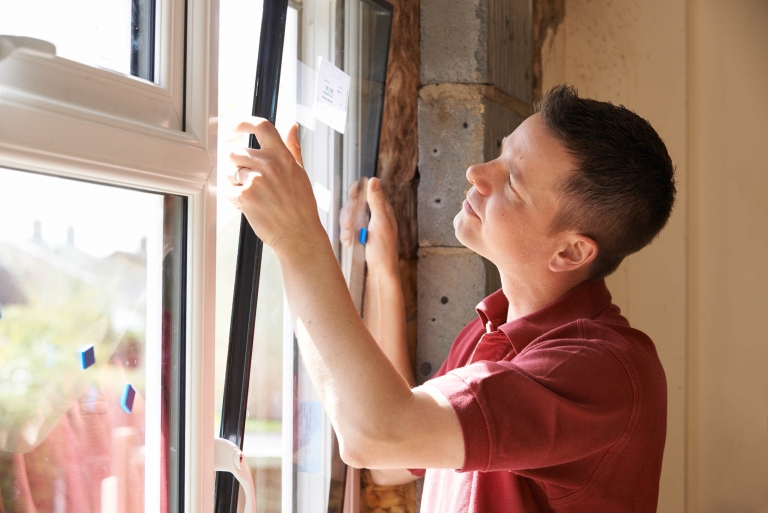
Here’s something the window showroom won’t always lead with: poor installation is the leading cause of window performance problems, including air leaks, water infiltration, and reduced insulation value. You can buy the best window on the market and lose half its efficiency to a sloppy install. This is not the project to hand to the lowest bidder or attempt yourself with a weekend and a YouTube playlist.
At Cransten, our licensed pros handle window installations across Northern Utah, the Denver area, and the Carolinas — properly sealed, properly finished, and backed by our 90-day warranty. Because the whole point of this project is keeping the outside air outside where it belongs.
Ready to Stop Paying to Cool the Neighborhood?
If your windows are old, drafty, or fogging up between the panes, summer is the perfect time to do something about it. Reach out to Cransten and let’s talk about what energy-efficient window replacement looks like for your home.
Licensed pros, protected payments, and a 90-day warranty – what more could you ask for?